
Learning How to Use These Buzzwords Correctly: Climate Finance, Sustainable Finance, and Spatial Finance

At a time when global challenges like climate change, resource scarcity, and economic inequality dominate discussions, finance is rapidly evolving to address these issues. Folks throw around terms like Climate Finance, Sustainable Finance, and Spatial Finance - as these terms are increasingly tossed around in boardroom discussions, geospatial conference panels, policy wonk happy hours, and however academics socialize.
While these three areas share overlapping goals, each term represents a distinct approach within the broader landscape of impact-driven financial strategies. Let's unpack the nuances of these three concepts, shedding light on their differences and why they matter.
1. Climate Finance: Saving the Planet, one Excel File at a Time
Definition:
Climate Finance refers to public and private financial flows that are targeted at mitigating climate change and adapting to its effect. Focusing specifically on funding projects and initiatives that reduce greenhouse gas emissions or increase resilience to climate impacts.
Key Characteristics:
Purpose-Driven: The primary goal is to support investments and actions aligned with global climate agreements(ie, the Paris Agreement.) Investments in renewable energy, carbon capture technologies, and climate-resilient infrastructure projects.
Funding: Often involves international transfers, such as climate aid from developed to developing nations, alongside private sector contributions.
Policy Framework: Guided by global and national climate policies, with significant involvement from entities like the Green Climate Fund, World Bank, and United Nations.
Project and Investment Examples:
Financing solar farms in emerging markets.
Funding coastal defenses to protect communities from rising sea levels.
Supporting reforestation projects to sequester carbon.
2. Sustainable Finance: Where Ethics Have a ROI
Definition:
Sustainable Finance encompasses financial activities that integrate Environmental, Social, and Governance (ESG) criteria as a key driver for investment decisions. Unlike Climate Finance, it casts a wider net, addressing a wide range of sustainability challenges.
Key Characteristics:
Triple Bottom Line: Focuses on the 3 Ps (People, Planet, and Profit,) ensuring investments deliver social and environmental benefits in addition to financial returns.
Cross-Sectoral Approach: Spans various industries and addresses issues like Gender Equality, Labor Rights, Clean Water, and Conservation of Biodiversity.
Mainstreaming ESG: Investors increasingly use ESG frameworks to evaluate risks and opportunities, with sustainable finance becoming central to institutional portfolios. (Note: I wrote sections of this before 5 November, so we’ll see how this plays out in the US)
Project and Investment Examples:
Green Bonds financing energy-efficient buildings.
Social Impact bonds supporting education or healthcare projects.
Private Equity funds targeting circular economy businesses.
3. Spatial Finance: Mapping out a Stronger Portfolio
Definition:
Spatial Finance is the integration of geospatial data and technologies into financial decision-making. It provides actionable insights for decision makers into Environmental Risks and opportunities at specific locations by leveraging Satellite Imagery/Earth Observation Data, Geospatial Analysis Techniques, and machine learning/GeoAI.
Key Characteristics:
Location-Centric: Focuses on the assessment the physical and environmental characteristics of assets, supply chains, or investment regions.
Tech-Driven: Utilizes EO Data, Remote Sensing, Geospatial Data and AI to monitor Land Use, Deforestation, Water Availability, and Disaster Risk in near real-time.
Risk and Impact Assessment: Plays a critical role in evaluating physical climate risks (e.g., flooding, wildfires) and ensuring assets are resilient to various perils and environmental impacts.
Project and Investment Examples:
Monitoring Deforestation linked to supply chains in Agriculture.
Assessing Flood risks for urban infrastructure portfolios.
Identifying renewable energy potential in specific geographic regions.
The TL;DR Table
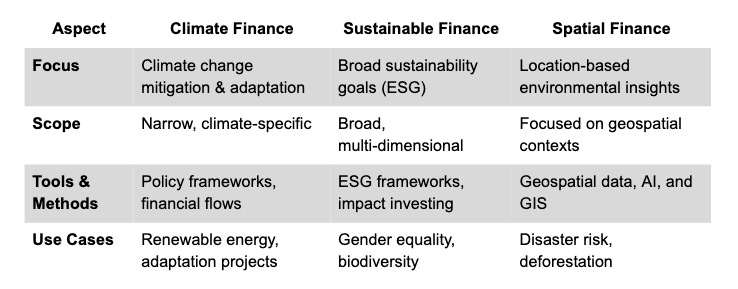
While Climate Finance is narrowly focused on addressing the climate crisis, Sustainable Finance uses a much wider lens, considering diverse environmental and social challenges. Spatial Finance acts mainly as the connective tissue, providing geospatial insights that add needed color to both Climate and Sustainable Finance strategies.
Mixing Up Your Buzzwords is so 2000 and Late
For financial folks, policymakers, and businesses, understanding these distinctions is critical for aligning investments with their desired impact. A climate-focused investor might prioritize Climate Finance opportunities, while a fund manager with a broader ESG mandate would look to Sustainable Finance. Meanwhile, Spatial Finance offers tools that empower both approaches, enhancing decision-making through precise data.
As global challenges grow in complexity, these financial paradigms will continue to evolve, working in tandem to drive positive change. By recognizing their unique attributes, stakeholders can leverage them effectively, ensuring capital flows where needed most.
Okay, I Read This, Now What?
If you want to deepen your understanding of Climate and Sustainable Finance or explore how Spatial Finance can help you focus on these fields with a geospatial point of view, reach out and let's have a zoom.